Staff planning reimagined: the optimal schedule at the touch of a button
15.04.2026
Automated staff planning significantly reduces the workload for those responsible for creating schedules. Instead of manually weighing up numerous and sometimes conflicting criteria, they delegate this task to a clearly defined optimisation process. By assigning specific weightings to different factors, the algorithm generates an optimal staff schedule that is transparent, traceable and reproducible.
The following is a summary of the presentation “Staff planning reimagined: the optimal schedule at the touch of a button” by Raphael Schmid, Head of the Workforce Management Business Unit at Ergon, delivered at HR Festival 2026 in Zurich.
Workforce planning is complex. This is already evident from the wide range of terminology used: in healthcare and emergency services, the term duty scheduling is most common. Shift planning is widely used in industry and logistics, while transport companies refer to route planning. In essence, all these terms describe the process of scheduling employees so that they know when, where and what they will be working.
A wide range of requirements
The greatest challenge in staff planning lies in taking a large number of requirements into account. These include hard constraints such as legal provisions, including working time legislation, internal company rules and industry-specific agreements. At the same time, soft constraints also play a crucial role: fairness, employees’ individual preferences, workload and time balances must be considered alongside qualifications and availability. Planning becomes particularly complex when external factors are involved, such as weather conditions that may affect absence rates, or unexpected events such as last-minute sick leave.
Another important consideration is fairness, which is defined differently depending on the industry and organisation. Night and weekend shifts vary in popularity and require either attractive compensation or equitable allocation. Planning tools must therefore provide flexible reporting functions that create transparency and ensure that all employees are treated fairly.
An optimisation problem
Viewed in this way, staff planning is not simply a planning problem but an optimisation problem. There is no single perfect schedule, but there is an optimal one. The key to managing this complexity lies in automation, always guided by human decision-making.
Modern planning tools use optimisation algorithms and heuristic search methods to generate an optimal staff schedule while taking all hard and soft constraints into account. Planners can define priorities, for example whether demand coverage or fairness should take precedence. Planning tools should also make use of planners’ implicit knowledge and incorporate contextual information such as the impact of weather conditions. The system then proposes the schedule with the best score, taking both legal requirements and individual preferences into consideration.
Practical examples
In practice, an integrated solution is essential: all relevant data, from legal requirements and qualifications to individual preferences, should be brought together in a single system. Mobile apps allow employees to enter their availability and preferences themselves, making the planning process more flexible and transparent.
The following example illustrates how automated planning works in practice: based on predefined priorities and planned absences such as holidays and training, the planning assistant in the ZESAM workforce management solution assigns employees to shifts.
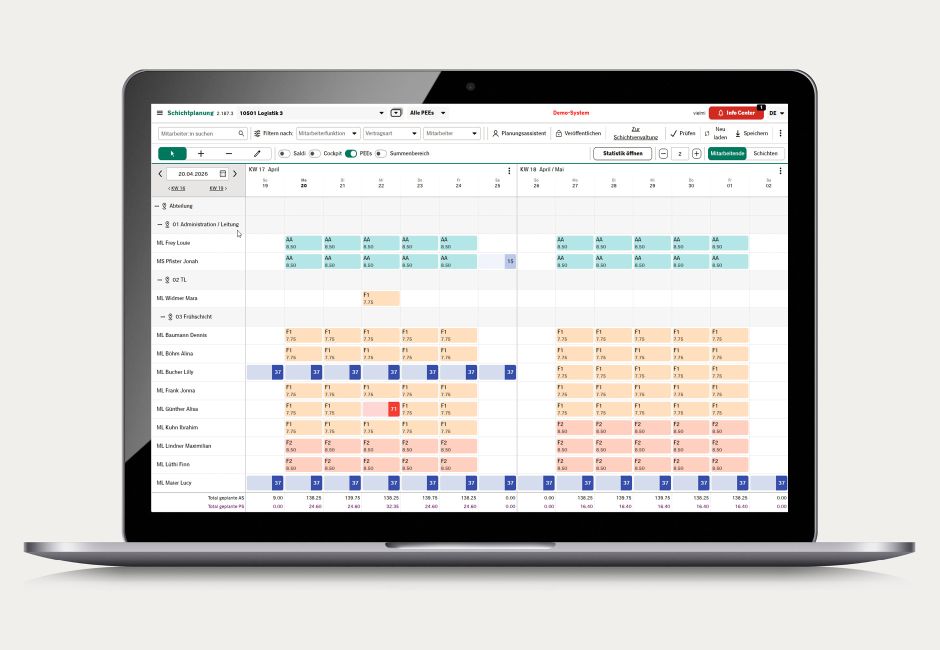
The system automatically generates a schedule and highlights gaps or imbalances. These can then be adjusted manually, for example by assigning suitably qualified employees from other teams.
In summary, automated staff planning saves time, ensures compliance and increases employee satisfaction. The key is for systems to take both hard and soft constraints into account while remaining flexible enough to respond to unexpected changes.