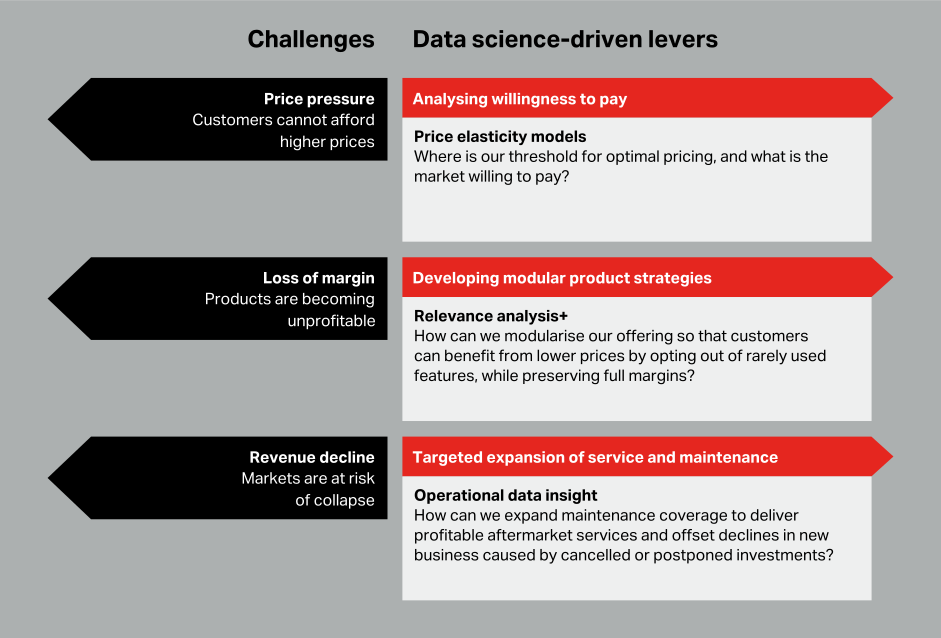
The strong Swiss franc, tariffs and volatile markets present significant challenges for industrial companies. As a result, management teams and boards of directors face a key question: how can we safeguard our competitiveness and financial resilience despite growing uncertainty and currency-related pressure?
A data-driven resilience strategy clearly shows where adjustments are possible, which products actually create value and how service and aftermarket business can cushion fluctuations in new business. This allows you to make decisions that have a measurable impact.
Approach based on the proof-of-value principle
Data-driven decisions are not made by chance; they follow a clearly structured process. In practice, a four-stage model has proven effective in quickly creating a robust basis for decision-making.
Within just a few weeks – typically 4 to 6 weeks – an open-ended question is transformed into a sound basis for decision-making.
1. Clearly define the problem
Firstly, the key business question is refined: What decision needs to be made and what are the primary objectives?
Result: A clear target picture and defined key performance indicators for evaluating the decision.
2. Establish a data foundation
The available data is analysed, structured and, where necessary, supplemented with external factors.
Result: A consolidated, robust data foundation on which to base all further analyses.
3. Understand interrelationships
Patterns, influencing factors and interrelationsships are made visible in order to identify the key levers.
Result: Concrete insights into what actually influences price, demand, margin or usage.
4. Validate decisions
Based on the analysis, scenarios and models are developed to assess the impact of potential measures.
Result: Robust decision-making foundations with clear recommendations and quantified business impact.

“Applying analytical thinking from other sectors opens up perspectives that often remain hidden within one’s own industry.”
The benefits with Ergon's data-driven resilience strategy
-
Validation of pricing strategies and market priorities based on actual willingness to pay
-
Identification of product and offering components that incur costs but do not create perceived customer value
-
Stabilisation of revenue through targeted expansion of service and aftermarket potential
-
Transparent scenarios and recommendations for senior management and the board of directors
-
A concrete roadmap with prioritised measures and quantified business impact
What makes a data-driven resilience strategy stand out?
Resilience as a strategic capability
A data-driven resilience strategy enables companies not only to withstand external shocks such as tariffs, exchange-rate fluctuations or declines in demand, but to actively manage them. It provides transparency on where risks arise and which measures actually have an impact.
Data as the basis for nuanced decisions
Rather than taking generic measures, such as blindly granting discounts, a data-driven strategy uses internal and external data to inform nuanced decisions regarding pricing, products and services. Economic impacts are quantified and alternatives are systematically compared.
From Proof of Value to operational management
It is not just the model that is important, but also its integration into decision-making processes. A data-driven resilience strategy combines analysis, validation and implementation, thereby becoming a sustainable component of corporate management.
We look forward to hearing from you
We are pleased that you are interested in our services. Do you have any questions or a specific project idea? Tell us about it – with no commitment on your part. Our experts will contact you as soon as possible.